What the Comb Remembers
For five generations, telling the Carrow bees a death has meant reading back what they build. Ffion just did the telling. Now she has to check.
Read by a full cast: your narrator tells the story, every character speaks in their own voice. About 7 minutes.
Narrators are synthetic voices designed for Flinchd or licensed from our speech provider, with invented names. None imitates a real person. Characters are cast automatically, so the person speaking is never the person narrating. A score matched to the genre plays underneath; turn it up or off in the player.
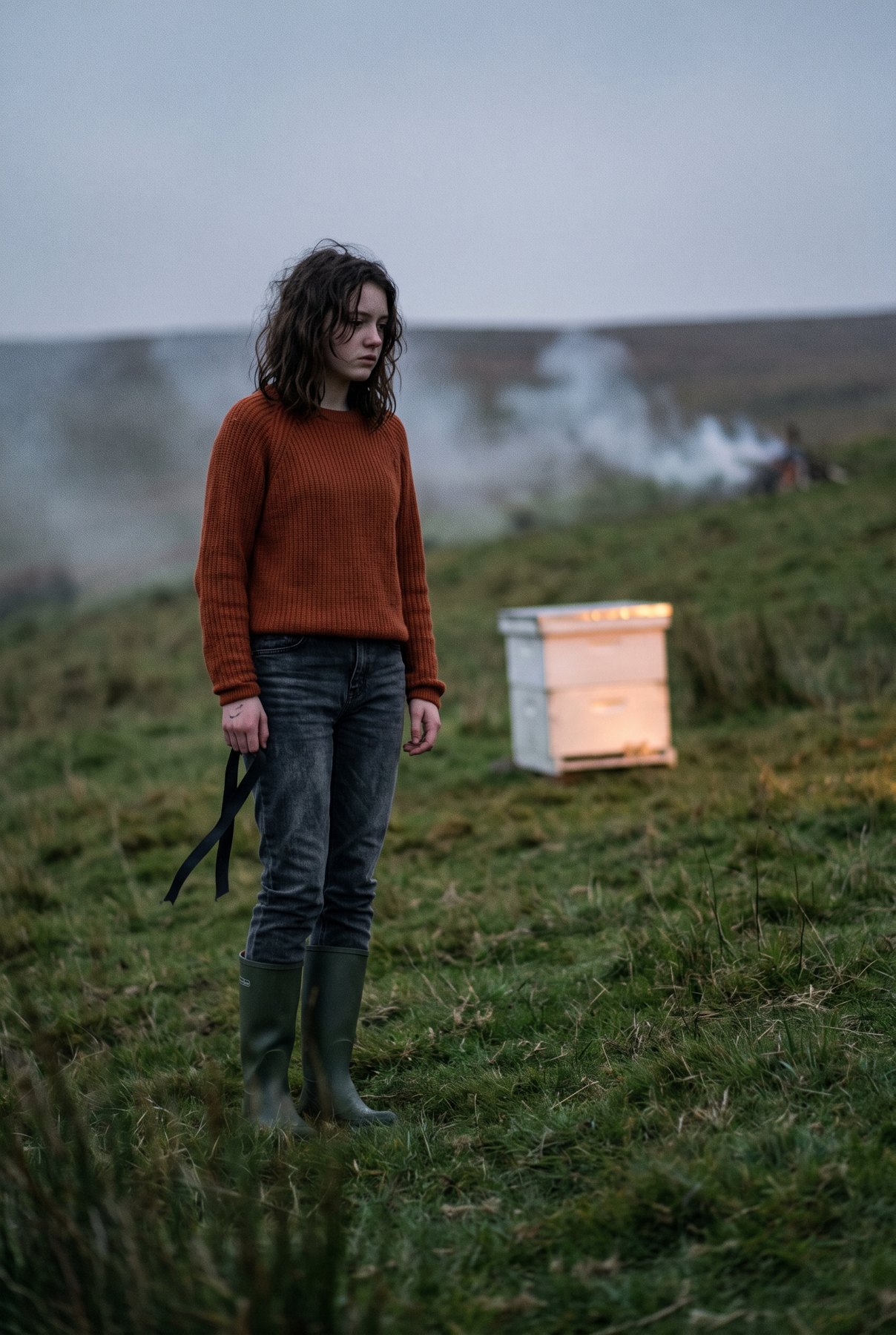
Ffion Carrow was halfway up the hill with the black ribbon still in its packet when she remembered nobody had actually told the bees yet.
She stopped so fast her wellingtons skidded in the wet grass. Nan had died on Tuesday morning, quietly, in her own bed, and it was now gone four on Tuesday afternoon. Every hour the bees didn't know, Delyth always said, was an hour they might decide to leave.
Below her the farmhouse still had its curtains half drawn, the way you left them for three days after a death, and the whole valley smelled of wet bracken and somebody's bonfire three fields over. Ffion had grown up thinking that smell meant autumn. Now she thought it might just mean this particular Tuesday, forever.
"They'll have felt it already," said Aunt Delyth, coming up behind her with a tin under one arm. "Bees know before we do, half the time. Doesn't mean we get to skip it."
Delyth had run Nan's nine hives since March, when Nan's hands stopped being steady enough for the smoker. She talked about the bees the way other people talked about the weather: an unavoidable fact you planned your day around.
"Knock twice." Delyth handed over the ribbon. "Wait for the hum to change, then say it plain — her full name, what happened, when. Step back after."
"Decide what, exactly?" Ffion said. "They're bees. They don't decide things."
Delyth didn't answer that. She never answered the questions that would have made her a liar either way.
Ffion counted the hives as she walked the row, the same nine there had always been, because counting was easier than the alternative and nobody in this family cried where the bees could hear. Nan's hive stood at the end, whitewashed, humming low and steady, one long unbroken note like a held breath.
She knocked twice on the lid, the way she'd been shown at eight years old for a wedding, and again at eleven for a birth. This was the first time she had done it for the other thing.
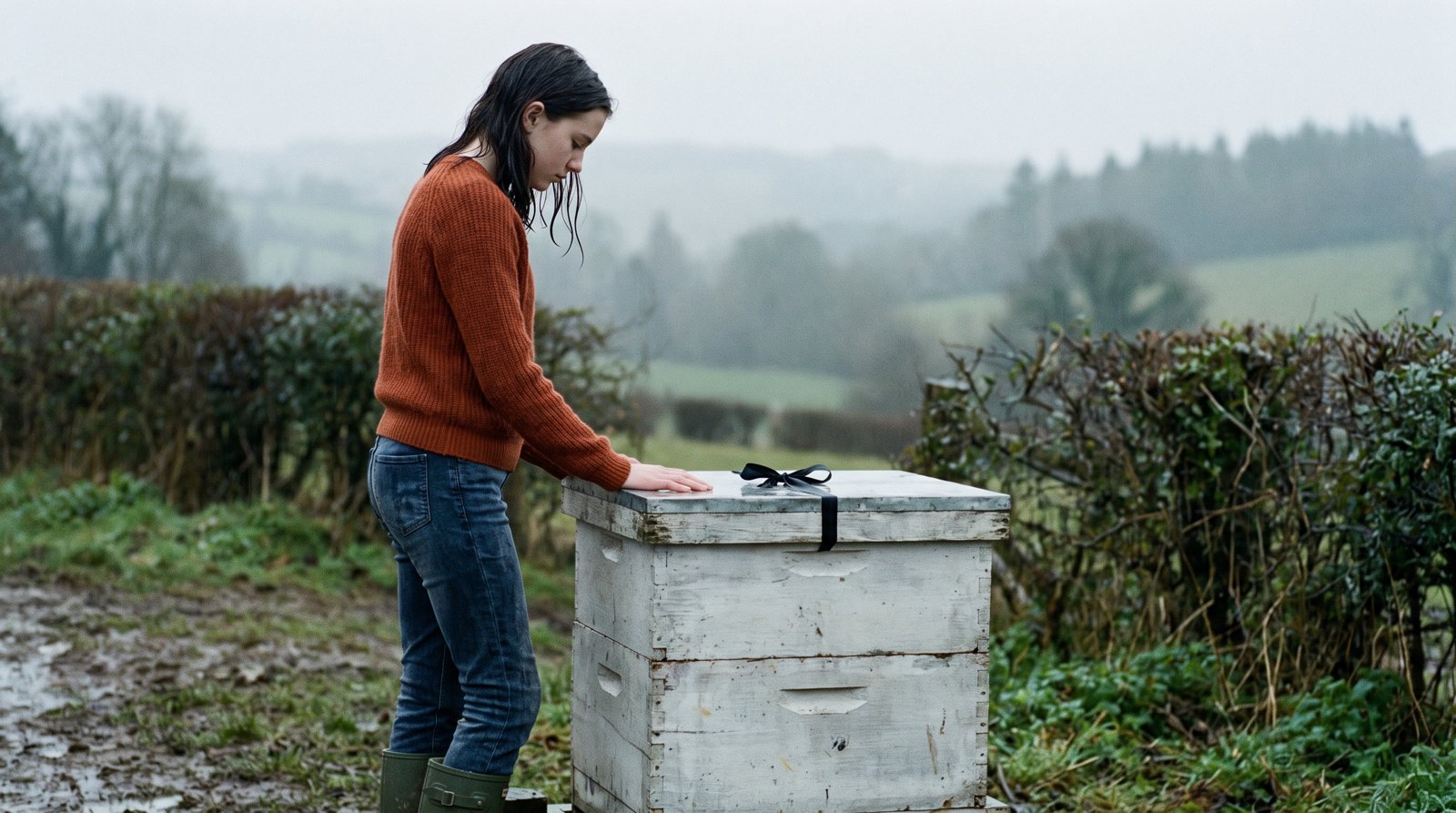
"Gwendolen Carrow died yesterday morning," she said, and her voice only shook on the surname. "In her bed. She was eighty-one, and it was her heart."
The note changed.
It didn't drop, exactly. It split, one pitch sliding under the old one until the whole hive was humming two notes at once, low and higher, like something singing harmony with itself. Ffion had heard that described her whole life. She had never once heard it happen.
She tied the ribbon on with fingers that weren't quite steady, stepped back the way she'd been taught, and the two-note hum followed her all the way down the hill into the kitchen, where Delyth had the tin open on the table already.
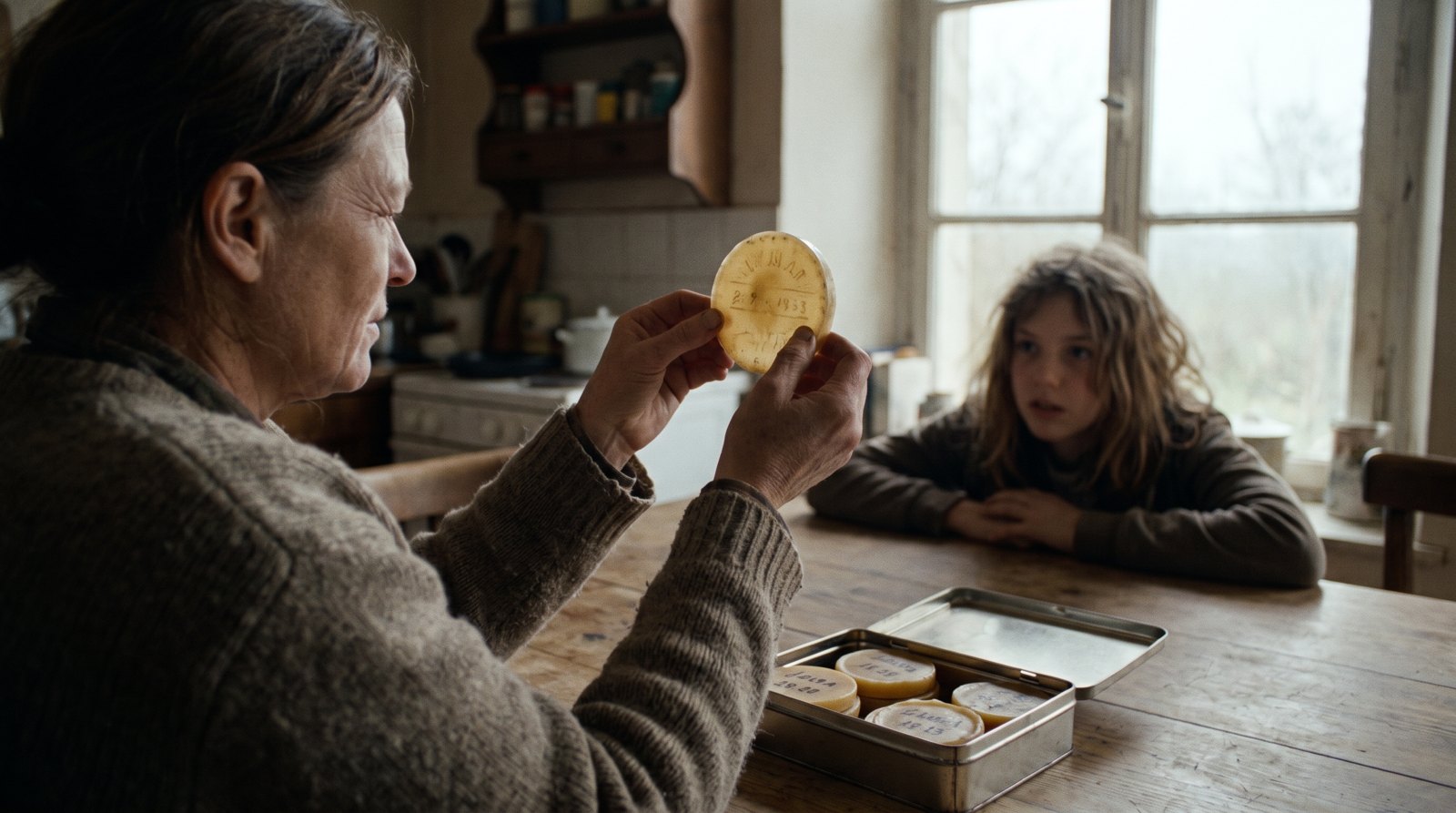
It wasn't empty. Ffion had always assumed, vaguely, that it held spare rubber bands and hive tools. Instead it held wax — dozens of small discs, pressed flat between squares of greaseproof paper, each one dated in Nan's small, upright hand.
"After every telling, the hive builds new comb in the next nine days," Delyth said. "Different from the rest. You press the first piece flat before it sets hard, and you hold it to a candle, and it shows you something."
"Shows you what?"
Delyth held one disc up to the kitchen window instead, the grey afternoon light doing the same job as a flame. Inside the wax, faint as a fossil, was the unmistakable curve of a bicycle wheel.
"My father," she said. "Went off his bike on the Cwmafan road, nine days almost to the hour after the hive built this."
Ffion's mouth had gone dry. "That's a coincidence. A hive full of a hundred thousand bees is going to build something round eventually."
Delyth held up a second disc: a shape like a rung, straight with a slight bow. "My mother's mother. Fell on the stairs at the chapel house."
A small flat oval came next, notched twice. "My sister Olwen's hearing aid battery. She died with it still in her hand, trying to put it back in."
The oldest disc was so brown with age it barely held its shape at all, but Delyth found it anyway, right at the bottom, under a square of paper gone soft as cloth.
"Great-great-grandmother pressed this one herself, they say, back when the hives were still skeps." A spoon, bent at the bowl. "Nobody living knows whose it was, or how. That's the other mercy — sometimes it runs out before it means anything to you."
Nobody in the kitchen was breathing especially well. Ffion counted the discs instead — twelve of them now, five generations, each one dated and small and ordinary and, once you knew what it meant, unbearable.
"Why keep them," Ffion said, "if you already know what they mean?"
"Because you don't." Delyth closed the tin, both hands, gentle as a lid on a coffin. "Not until afterwards. You only understand the shape once it's already happened to somebody."
There was a new one setting up the hill right now, she said. Nine days from today. Ffion's to press, if she wanted the job.
Ffion said she didn't want the job. Twice, in fact, the second time louder, and Delyth only nodded and put the tin back on the dresser, where it had apparently lived Ffion's entire childhood without her once wondering what was inside it.
Her mother was at the sink when Ffion came in, rinsing a mug she'd already rinsed. Carys had Nan's chin and Nan's habit of finding a chore the moment a room got too quiet.
"Your aunt showing you the bee business?" Carys said, not turning round. There was a rasp under the words, the kind that meant her chest was bad this week, and the blue inhaler sat on the windowsill where it lived every autumn.
"Something like that," Ffion said, and didn't say more, and her mother didn't ask, because asking about the hives had never once got a straight answer out of anybody in this family and she'd stopped expecting one.
Ffion thought about it anyway, obviously, for nine days. She thought about that inhaler on the windowsill, and whether the wax up on the hill was quietly working itself into that exact shape.
She did her homework. She ate her tea. She did not go up to look, because Delyth had said once, offhand, that checking early called the shape in early, and nobody in this family had ever tested that.
On the ninth day, she went up the hill.
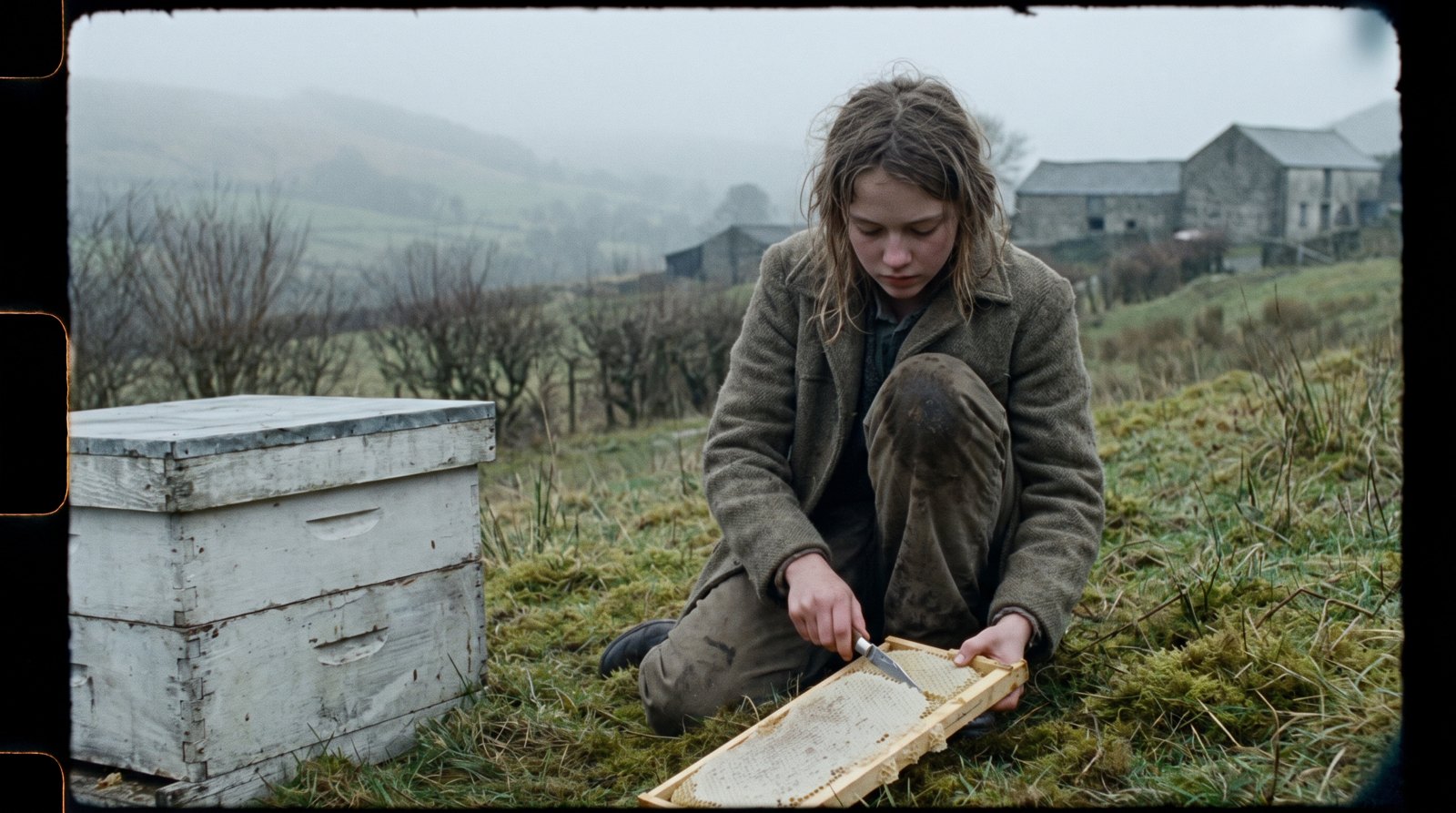
The comb was there, pale against the older wax around it, exactly where Delyth had said it would be — a section no bigger than a coaster.
That morning Delyth had pressed a penknife into her hand at the door. "So you'll always have one on you, love," she'd said. "Everyone in this family does. Take it." Ffion had put it in her coat pocket without thinking twice.
She used it now to cut the comb free, and carried it down to the kitchen window before the wax could warm and lose its shape.
She held it up to the grey light, braced for an inhaler.
It wasn't an inhaler.
It was small and narrow, with a shallow curve along one edge and a notch near the tip where a thumb would rest to open it. She knew that shape. She was holding it, warm from her own pocket, in her other hand.
The knife had not existed in this house yesterday. The wax had finished setting nine days ago, before Delyth ever thought to give it to her.
Ffion set both objects down on the table, side by side, very carefully, and did not tell her mother anything at all.