
The Cold Seam
A rigger sent to close the books on a fourteen-year-old repair finds the old weld still has something to say.
Read by a full cast: your narrator tells the story, every character speaks in their own voice. About 7 minutes.
Narrators are synthetic voices designed for Flinchd or licensed from our speech provider, with invented names. None imitates a real person. Characters are cast automatically, so the person speaking is never the person narrating. A score matched to the genre plays underneath; turn it up or off in the player.
Wren Adisa was three rungs from the end of her tether when the seam under her glove tapped back.
She froze with her sounding rod still braced against her jaw, the steel humming faint and metallic through her back teeth, and told herself it was thermal creep. Corrigan's Reach groaned at every sunrise, forty minutes of hull expanding a millimeter at a time. That was a groan, though. This was three taps, a pause, two taps, a pause, three taps. Then nothing, for the length of time it took her heart to catch up with itself.
"Ground, this is Adisa, Section Nineteen." Her voice sounded steadier in the helmet than it felt in her chest. "Tell me somebody's running a compressor test on the old ring."
"Negative, Nineteen's cold." Costas, in the shack, bored already. "Nineteen's been cold since before you had your ticket. You certifying the seam or not? Grind crew wants it by shift change."
She didn't answer right away. She pressed the rod flat again, found the spot, and waited.
Three. Two. Three.
Nobody had taught Wren that pattern in a classroom. Every rigger who'd ever worked a cold ring learned it hand to hand, off-book, the way you learn which stairs creak in a house you grew up in: three-two-three meant still here, the oldest line in shell-crew code, older than the Reach itself, carried by people who used to bang pipes in mine shafts to tell the surface they hadn't died yet.
"Costas. I need the maintenance log for this seam. Full history, not the summary."
"Why. It's a grind job, Adisa, not an investigation."

"Humor me."
He did, with the particular sigh of a man doing something he considered a favor. The log crawled up her visor in green text while she kept the rod against the metal, against the small, patient rhythm that would not, could not, be thermal creep, because thermal creep did not pause for exactly the same three seconds every time.
Section Nineteen had cold-sealed fourteen years ago, after an ore-crusher fire ate the atmosphere out of four decks before anyone could get a door shut on it. Company policy past the inner ring was simple and, on paper, humane: vent the breach, let vacuum do in ninety seconds what firefighting foam couldn't do in nine hours, and let the bare structural steel find itself.
Two clean faces of metal, stripped of every molecule of oxide by the vacuum itself, didn't need heat or filler to become one piece. They just touched, and forgot, instantly and permanently, that they had ever been two things.
No power required. No maintenance, ever. Cheaper than any airlock ever built, and it never failed, because there was nothing left inside it to fail.
The only cost was that once a seam like that cured, you did not reopen it. Cutting it meant cutting a bond stronger than the plate around it, and that meant compromising the whole ring for everyone still breathing on the right side of the wall.
So the rule, also on paper, also humane: anyone unaccounted for when a section sealed stayed on the manifest for thirty days, in case they turned up on a supply run or a bad joke. After that, presumed vented. Cause of death: the vacuum, not the company, not the schedule, not the person who'd signed the order to seal early because the fire was spreading and there wasn't time to run a headcount.
One name sat at the bottom of the Nineteen file, flagged and closed thirteen years and eleven months ago, thirty days to the hour after the seal cured. Voss, D. Rigger, second class. Presumed vented. Cut off from the rest of the crew seventy-one hours before the file said the crusher fire even reached that deck.
Seventy-one hours was enough for a person in a suit to find an air pocket. Long enough to ration a tank. Nowhere near long enough to explain fourteen years of three taps, a pause, two taps, a pause, three.
"Costas." She made herself say it plainly, the way you'd report a cracked strut and not a ghost. "There's someone signaling from inside Nineteen."

A silence came down the line that had nothing to do with static.
"That seam's fourteen years cured," he said finally. "Nobody's alive in there, Adisa. You know the physics as well as I do."
"I know the physics says the tapping shouldn't be happening either. It's happening anyway."
"Metal settles. Old welds pop and shift for decades, that's textbook, that's every rigger's first lesson—"
"Not in threes. Not with the same gap every time. I counted, Costas. I counted it four times."
He didn't argue the counting. That was almost worse than if he had.
"Say it's real," he said at last, quiet now, like he didn't want the shack picking it up. "Say there's something in there tapping code at you. What exactly do you want me to do. Send a torch crew to cut a hole that could crack the whole ring and kill forty people to maybe find a body, because that's what fourteen years makes it, Adisa, a body, and you know that too."
She did know it. She had known it since the second gap, the exact length of a held breath, that told her whatever was answering her had learned patience a long time ago.
"I'm not asking you to open it," she said. "I'm asking you to hold the grind."
"Grind crew's been scheduled a month. That plate's going into the new mess-hall bulkhead on Twenty-Four, and it is not going to sit here going soft on us over a noise nobody but you has heard." A pause, and then, gentler, the question-for-a-question habit she'd stopped noticing years ago because it was so completely him. "You want to tell me what you think holding it accomplishes?"
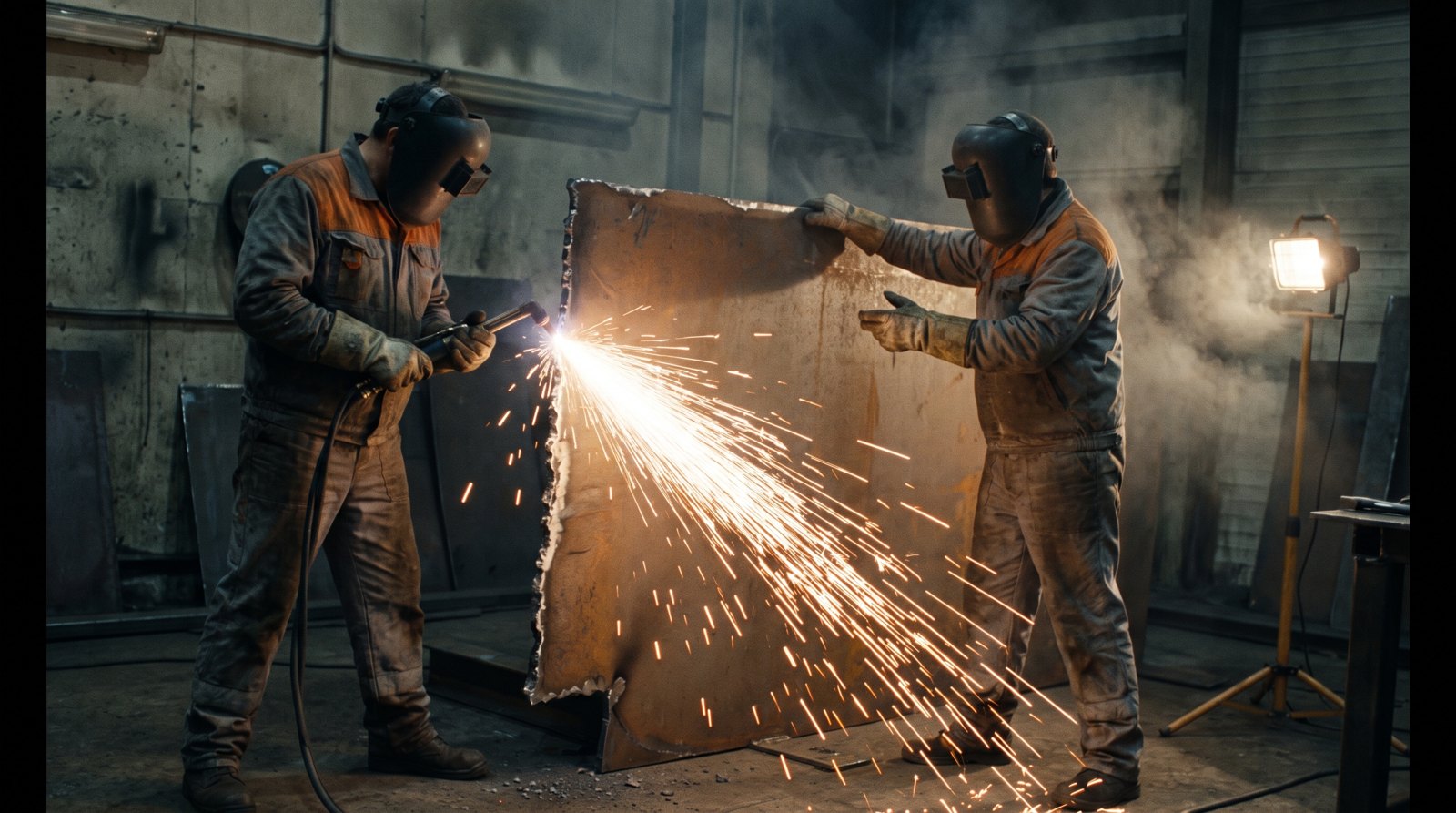
She didn't have an answer that would survive a budget meeting. She had a rod against her jaw and a rhythm in her back teeth that had been going since before she was old enough to hold a wrench, and the small, useless certainty that whatever was in there deserved one more thing to hear before Twenty-Four's new wall swallowed it whole.
"Nothing," she admitted. "It accomplishes nothing."
"Then get back inside. Shift's over."
She didn't get back inside, not yet. She stayed out past the end of her tether's slack, rod against the seam, and she tapped back. Three. Two. Three. Still here.
Then, slower, she tapped out her own name, letter by numbered letter, the code her hands had known since training — so that whatever was on the other side of fourteen years and however many inches of fused steel would know that a person, not just a procedure, had finally been listening.
The gap that came back was longer than any before it. Then three-two-three again, steadier, like something had exhaled.
The grind crew took Section Nineteen's outer plate on schedule, cut it to spec, and folded it into the new bulkhead behind the mess hall on Deck Twenty-Four, the same shining metal wearing a fresh coat of primer and a name nobody read anymore.
Wren didn't watch. She signed the certification, because the seam had tested sound, because the schedule didn't have a box for what she'd heard, and because some part of her still believed the record ought to say the truth even if the truth changed nothing.
Six weeks later, a new hire mentioned it over the mess hall's good coffee, half laughing, the way you tell a story you don't quite believe yourself: something behind the wall by the coffee station, she swore, tapping some pattern, three of something, over and over, and there was nothing back there, she'd checked the schematics herself, no cavity, no conduit, nothing but a foot and a half of solid, seamless plate.
Wren set down her mug. "Which section did that plate come from," she said. "And has anyone answered it back yet?"